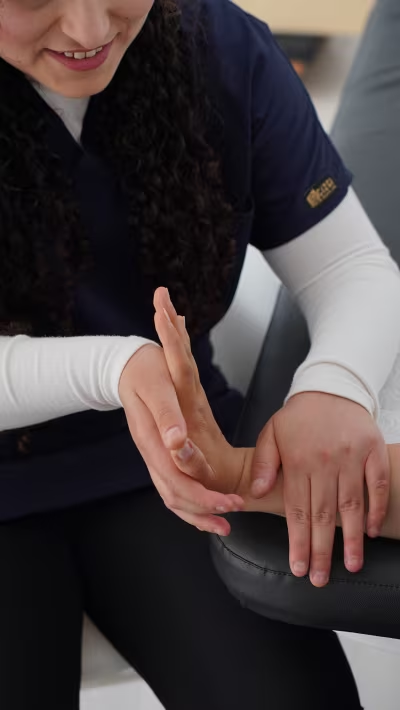
Whether after a stroke, for a developmental delay in childhood, or due to age-related limitations in everyday life: occupational therapy helps people of all ages regain or maintain independence. Yet many people remain unsure who covers the cost, whether a doctor's referral is required, and how to actually find the right provider in Austria. This article clears things up, with current facts and figures for 2026.
What is occupational therapy, and who is it for?
Occupational therapy supports people whose physical, mental, or social functioning is impaired, limiting their ability to manage daily activities. The goal is participation in "meaningful occupations" — getting dressed, eating, writing, working, learning, or safely managing a household.
Typical areas of application include:
Neurology: after a stroke, traumatic brain injury, multiple sclerosis, or other neurological conditions
Pediatrics: developmental delays, fine or gross motor difficulties, ADHD, or autism spectrum conditions in childhood
Orthopedics/hand surgery: after injuries or operations to the hand or arm
Geriatrics: age-related limitations, for example after a fall or as part of dementia care
Psychiatry: stabilizing daily structure and social participation in the context of mental illness
Occupational therapists don't just work on the exercise itself — they also help adapt a person's environment and advise on and select suitable assistive devices.
Costs and cost coverage: contracted therapist vs. private therapist
As with many health professions in Austria, there are two paths for occupational therapy:
1. Contracted providers (health insurance panel therapists)
If you see a therapist under direct contract with your health insurance fund (such as the ÖGK), treatment is free of charge upon presentation of a valid medical referral — billing happens directly between the practice and the insurance fund. Depending on the fund, a small co-payment may apply.
2. Private ("Wahltherapeut") providers with partial reimbursement
If you choose a therapist without an insurance contract, you pay the fee yourself upfront and then submit the referral and invoice to your insurance fund. In this case, the ÖGK reimburses 80 percent of the rate it would pay a contracted occupational therapist for the same service. Exact rates are set out in the ÖGK's own fee schedules for contracted providers and vary by service.
Referral and prior approval
To have costs covered, you generally need a medical referral from:
a general practitioner,
a specialist in neurology, orthopedics, or pediatrics, or
a hospital department.
For ÖGK and BVAEB members, no separate prior approval is currently required before starting treatment — the referral is sufficient. For SVS and KFA, prior approval may be required; it's worth checking with your specific fund beforehand.
How does occupational therapy work in practice?
The process typically follows a clear structure:
Initial consultation and assessment: The therapist evaluates the current situation, limitations, and available resources.
Joint goal-setting: The patient (or, for children, the parents/guardians) and therapist agree on treatment goals together.
Therapy sessions: Hands-on training — for example grip, fine or gross motor exercises, memory training, activities-of-daily-living training, or guidance on assistive devices.
Evaluation: At the end of the treatment process, progress toward the agreed goals is reviewed.
Occupational therapy takes place in a variety of settings: private practices, outpatient clinics, primary care centers, hospitals, rehabilitation centers, and also as home visits.
Training and the protected professional title
The professional title "occupational therapist" ("Ergotherapeut/in") is legally protected in Austria and regulated under the MTD Act (the law governing advanced medical-technical health professions). Beyond completing the required training, practitioners must be registered in the national Health Professions Register.
Training takes the form of a Bachelor's degree (Bachelor of Science in Health Studies, 180 ECTS) over six semesters full-time or eight semesters part-time, offered at nine university of applied sciences (Fachhochschule) locations across Austria — including Vienna, Linz, Salzburg, Innsbruck, and Klagenfurt. These programs are accredited by the World Federation of Occupational Therapists (WFOT). Practitioners are also legally required to complete at least 60 hours of continuing education every five years.
Waiting times and workforce shortages
Occupational therapy is one of seven professions within Austria's advanced medical-technical services (MTD). According to a workforce forecast by Gesundheit Österreich GmbH, at least 10,100 newly trained professionals will be needed nationwide across these seven professions by 2030. The resulting shortage can lead to longer waiting times for a publicly funded (contracted) place, depending on the region — one more reason to start your search early and consider private ("Wahltherapeut") providers as well.
Finding the right occupational therapist
Whether you're looking for a contracted provider or a private therapist, what matters most is finding a qualified professional near you, registered in the Health Professions Register, with the right specialization for your needs. Use Find therapists near you to search specifically for occupational therapists in your area — filtered by focus area (e.g. pediatrics, neurology, hand therapy), availability, and insurance contract status.
Frequently asked questions about occupational therapy in Austria (FAQ)
Do I always need a doctor's referral for occupational therapy? Yes. To have costs covered by your health insurance fund, you need a referral from a general practitioner, certain specialists (neurology, orthopedics, pediatrics), or a hospital department.
How much does the ÖGK reimburse for a private (non-contracted) occupational therapist? The ÖGK reimburses 80 percent of the amount it would pay a contracted occupational therapist for the same service. The exact amount depends on the specific service provided.
Is occupational therapy only for children, or also for adults and seniors? Occupational therapy serves people of all ages — from children with developmental differences, to adults recovering from accidents or surgery, to seniors dealing with age-related limitations or dementia.
How is occupational therapy different from physiotherapy? Physiotherapy mainly focuses on the musculoskeletal system, muscles, and mobility. Occupational therapy takes a broader approach: it targets the ability to carry out specific everyday activities (such as dressing, cooking, or working) and also considers a person's home and work environment along with assistive devices.
Do I need prior approval before starting treatment if I have ÖGK insurance? No separate prior approval is currently required for ÖGK or BVAEB members — the medical referral is sufficient. For SVS and KFA members, prior approval may be required; this should be confirmed with the relevant fund on a case-by-case basis.
Conclusion
Occupational therapy is a key building block for regaining or maintaining everyday independence after illness or injury, or in the context of developmental differences — for children, adults, and seniors alike. With a valid medical referral, treatment with a contracted provider is free of charge; with a private provider, the ÖGK covers 80 percent of the contracted rate. Given the noticeable workforce shortage, it pays to start your search early and target it well.
Find occupational therapists near you now — fast, straightforward, and filtered to your needs on Therapeutensuche.at.
Sources
ÖGK – Information for Contracted Providers: Occupational Therapy
MTD-Austria – Austria Needs More MTD Professionals (Workforce Forecast to 2030)
Image source: Photo by Anete Lusina on Pexels, Pexels License (free to use). Direct link: https://images.pexels.com/photos/6353854/pexels-photo-6353854.jpeg